Academic Referencing Correction Service for New Zealand Students
Introduction
Academic referencing is one of the most important parts of university writing. It shows where your information, ideas and evidence came from and allows readers to locate the original sources.
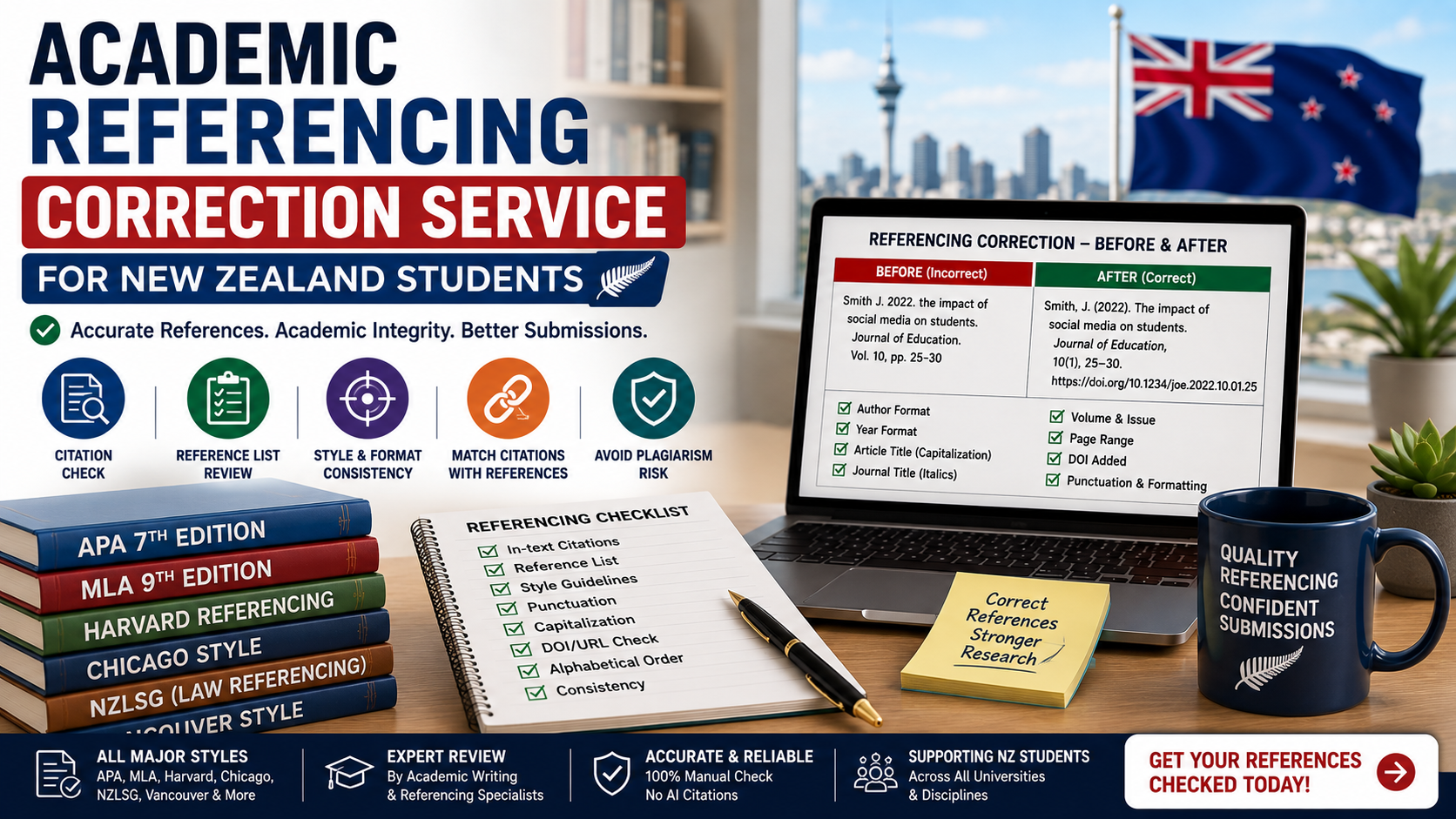
For New Zealand university students, referencing requirements can vary between subjects, faculties and institutions. APA, MLA, Chicago, Harvard, NZLSG and other referencing systems may be used depending on the discipline and course requirements. Te Herenga Waka—Victoria University of Wellington, for example, notes that students should check their course outline or ask their supervisor which referencing style their subject requires.
A single incorrect citation may seem minor, but inconsistent or incomplete referencing throughout an assignment can create significant problems.
An academic referencing correction service can provide a final review of citations, reference lists, formatting and consistency while allowing students to retain responsibility for their own academic work.
What Is an Academic Referencing Correction Service?
An academic referencing correction service reviews an existing assignment, essay, report, research paper or dissertation to identify referencing problems.
Depending on the agreed scope, a referencing review may check:
In-text citations
Reference-list entries
Bibliographies
Footnotes
Endnotes
Citation-to-reference matching
Author names
Publication dates
Titles
Journal details
Book details
DOI information
URLs
Page numbers
Quotation citations
Paraphrased material
Alphabetical order
Hanging indents
Referencing-style consistency
The objective is to correct and standardise referencing, not to create an academic argument or write an assessed assignment for the student.
The University of Auckland's guidance on third-party assistance specifically recognises that third parties may provide advice on referencing, including completeness and internal consistency of citations, bibliographies, reference lists, endnotes, footnotes and cross-references.
Why Is Correct Referencing Important?
Referencing serves several purposes in academic writing.
It helps students:
Acknowledge other people's ideas.
Support arguments with evidence.
Allow readers to locate original sources.
Distinguish their own ideas from borrowed material.
Demonstrate academic research.
Avoid plagiarism and other academic-integrity problems.
The University of Auckland describes academic integrity as including acknowledgement of the work and ideas of others. It also states that students are responsible for ensuring that their academic work is honest and properly acknowledges sources.
Referencing Errors Can Happen Easily
Referencing becomes complicated when an assignment contains dozens of sources.
For example, a student may have:
25 journal articles
5 books
8 websites
3 government reports
2 datasets
Several direct quotations
Each source may require different information and formatting.
Common mistakes include:
Missing publication dates
Incorrect author names
Missing page numbers
Incorrect journal volume information
Incorrect URLs
Missing DOI
Incorrect italics
Incorrect punctuation
Wrong citation style
Sources cited in the text but missing from the reference list
References listed but never cited
A final referencing correction can help identify these inconsistencies.
Common Referencing Styles Used by NZ Students
New Zealand students may encounter different referencing styles depending on their discipline.
Common examples include:
APA
MLA
Chicago
Harvard
NZLSG
Vancouver
IEEE
Discipline-specific styles
Te Herenga Waka—Victoria University of Wellington lists APA, MLA, Chicago, Harvard, NZLSG and IEEE among common referencing styles and advises students to check the style used by their subject.
The University of Auckland's referencing resources similarly provide guidance for multiple styles, including APA, MLA, Chicago, ACS, NZLSG and Vancouver.
Important: Never choose a referencing style simply because it is familiar. Always follow your course or department's requirements.
APA 7 Referencing Correction
APA 7 is widely used across disciplines such as psychology, education, business, health and social sciences.
An APA referencing correction may check:
Author-date citations
Narrative citations
Parenthetical citations
Multiple-author formatting
Direct quotations
Page numbers
Reference-list order
Journal article formatting
Book references
Website references
DOI formatting
Headings and reference formatting
Students should use their university's current APA guidance where available.
The University of Auckland provides referencing resources and examples through its referencing service, including QuickCite examples for major referencing styles.
MLA Referencing Correction
MLA is commonly associated with disciplines involving literature, languages and humanities.
A referencing review may check:
Author information
Page references
In-text citation format
Works Cited entries
Titles
Publication information
Ordering
Formatting consistency
Because referencing systems change over time, students should use the version and rules specified by their course.
Chicago Referencing Correction
Chicago style can involve different systems, including notes and bibliography or author-date referencing.
A correction service may review:
Footnotes
Endnotes
Bibliography
Author-date citations
Publication information
Page references
Punctuation
Ordering
Formatting
Students should confirm which Chicago system their course requires.
NZLSG Referencing for Law Students
Law students in New Zealand may encounter the New Zealand Law Style Guide (NZLSG).
Legal referencing can be particularly detailed because students may need to reference:
Cases
Legislation
Regulations
Books
Journal articles
Websites
Parliamentary material
Treaty-related material
International legal sources
A referencing correction review can identify inconsistencies in legal citations and help students check whether references follow the required legal style.
Students should always follow the specific legal referencing requirements of their law school.
Vancouver Referencing Correction
Vancouver-style referencing is commonly associated with health, medical and scientific disciplines.
Unlike author-date systems, Vancouver commonly uses numbered citations.
A final review can check:
Citation numbering
Citation order
Reference numbering
Journal references
Author formatting
Page ranges
DOI information
Consistency between citations and references
One numbering error can affect every citation that follows it, making a final review particularly useful.
Harvard Referencing Correction
Harvard referencing is an author-date system, but there are different versions of Harvard style.
This is important.
There is no single universal "Harvard style" that every institution uses identically.
A correction service should therefore work from the specific Harvard guidelines provided by the student's university or department.
What Does an Academic Referencing Correction Service Check?
A detailed referencing review can be divided into several stages.
1. Referencing Style Identification
First determine which style the assignment requires.
For example:
APA 7 → Psychology
NZLSG → Law
Vancouver → Health/Medical
MLA → Humanities
These are examples only. The student's actual course instructions should take priority.
2. In-Text Citation Check
Every citation should be reviewed for consistency.
Check:
Author name
Year
Citation placement
Number of authors
Page number where required
Punctuation
Multiple-source formatting
Direct quotations
Paraphrasing
3. Reference List Check
The reference list should be checked separately.
Look for:
Missing references
Duplicate references
Incorrect ordering
Incomplete publication information
Incorrect titles
Incorrect author details
Missing DOI
Incorrect URLs
Formatting inconsistencies
4. Citation-to-Reference Matching
One of the most useful final checks is matching citations with references.
For example:
In-text citation:
(Smith, 2025)
Reference list:
Smith, J. (2025). Research methods in higher education. Academic Press.
The reviewer should check whether the citation and reference correspond correctly.
Then perform the reverse check.
Every reference-list entry should be checked to determine whether it is actually cited in the assignment where required by the chosen style.
5. Direct Quote Check
Direct quotations require particular attention.
Check:
Quotation marks
Author
Publication year
Page number or location information where required
Exact wording
Citation placement
Students should never change a quotation while presenting it as an exact quotation.
6. Paraphrasing and Citation Check
Paraphrasing does not automatically remove the need for citation.
If an idea, argument, finding or information comes from another source, it generally needs appropriate acknowledgement according to the required referencing style.
The University of Auckland explains that information and ideas from other people need to be acknowledged appropriately, and its academic-integrity guidance emphasises the student's responsibility for correct attribution.
7. Reference Formatting
A reference may contain the correct information but still be formatted incorrectly.
A review can check:
Italics
Capitalisation
Punctuation
Indentation
Spacing
Ordering
DOI presentation
URL presentation
The exact rules depend on the referencing style.
8. Online Sources
Web sources can be especially difficult to reference because students may not always know:
Author
Organisation
Publication date
Page title
Website title
URL
Update date
Students should avoid treating every website as an equivalent academic source.
A referencing correction service can identify incomplete website references, but students should also evaluate whether a source is academically appropriate for the assignment.
9. Journal Articles
Journal articles may require information such as:
Authors
Year
Article title
Journal title
Volume
Issue
Page range
DOI
Missing or incorrectly formatted information can make the reference difficult for a reader to locate.
10. Books and Book Chapters
Book references may require:
Author
Year
Book title
Edition
Publisher
Editors where applicable
Chapter title
Page range where required
The exact format depends on the referencing style.
11. Government and Institutional Reports
Students frequently use sources from:
Government departments
Ministries
Universities
Research institutes
International organisations
Professional bodies
These sources can require different treatment from ordinary journal articles.
Always follow the appropriate style guide rather than creating a format from memory.
Referencing Correction for International Students in New Zealand
International students may already be familiar with a referencing system from another country or university.
However, the conventions used at a New Zealand university may differ from those used in another educational system.
Common challenges include:
Different citation styles
Different quotation conventions
Different punctuation rules
Different reference-list formats
Different legal citation systems
Different expectations around academic sources
Students should therefore follow the referencing requirements of their current New Zealand institution.
Why Referencing Software Does Not Eliminate Errors
Reference-management tools can save time, but they are not perfect.
Tools may import incomplete or incorrect metadata.
For example, a database might incorrectly record:
Author names
Publication dates
Titles
Journal information
DOI details
Students should review automatically generated references before submission.
The University of Auckland provides reference-management resources, including guidance on reference-management tools such as RefWorks.
What About ChatGPT and AI Referencing?
AI tools can generate citation suggestions, but students should not automatically trust AI-generated references.
AI systems may produce:
Incorrect references
Non-existent papers
Incorrect authors
Wrong publication dates
Incorrect journal details
Broken URLs
Incorrect quotations
Every reference should be verified against the original source.
Students should also check their course's current AI policy before using AI for assessed work.
Academic Integrity and Referencing
Correct referencing is closely connected to academic integrity.
The University of Auckland states that academic integrity involves acknowledging the work of others and that students are responsible for academic honesty.
Its current Student Academic Conduct Statute identifies inadequate acknowledgement and referencing of other people's work as a form of academic-integrity breach.
This can include:
Ideas
Words
Data
Tables
Figures
Diagrams
Published material
Unpublished material
Students should therefore treat referencing as more than a formatting exercise.
It is part of responsible academic scholarship.
Can Students Use Third-Party Referencing Correction?
The answer depends on the university, course and type of assistance.
For example, the University of Auckland's third-party assistance guidelines state that third parties may provide advice on referencing, including checking completeness and internal consistency. The same guidelines state that third parties should not write or rewrite assessment work.
This distinction is important.
A referencing correction service should focus on reviewing and correcting referencing issues in the student's existing work rather than creating the assignment itself.
Students should always check their own university and course requirements.
Academic Referencing Correction vs Assignment Writing
These services should not be confused.
Referencing Correction
Focuses on:
Citations
Reference lists
Bibliographies
Footnotes
Formatting
Consistency
Citation matching
Assignment Writing
Involves producing:
Arguments
Analysis
Research
Structure
Conclusions
Original academic content
A referencing correction service should not replace the student's intellectual contribution.
Final Referencing Checklist for NZ University Students
Before submitting an assignment, check:
I know which referencing style my course requires.
Every borrowed idea has appropriate acknowledgement.
Direct quotations are clearly identified.
Quotations contain required location information.
In-text citations are correctly formatted.
Author names are accurate.
Publication dates are accurate.
Every required citation appears in the reference list.
Reference-list entries correspond to citations.
There are no unnecessary duplicate references.
Journal details are complete.
Book details are complete.
Website information is accurate.
DOI information is correct where required.
URLs have been checked.
Reference formatting is consistent.
Alphabetical or numerical ordering is correct.
Footnotes and endnotes have been checked where applicable.
Tables and figures have appropriate source acknowledgements.
I have checked my university's referencing guidance.
I have checked my course outline.
I have verified any AI-generated citation suggestions.
I have checked the academic-integrity requirements.
Academic Referencing Correction for Different Assignment Types
Essay Referencing
Check:
In-text citations
Evidence
Reference list
Direct quotations
Paraphrasing
Report Referencing
Also check:
Tables
Figures
Executive summary sources
Recommendations
Appendices
Research Paper Referencing
Pay particular attention to:
Literature review sources
Methodology references
Statistical sources
Research instruments
Data sources
Discussion references
Case Study Referencing
Check whether:
Case information is sourced
Theoretical models are referenced
Evidence is cited
Recommendations are supported
Dissertation and Thesis Referencing
Long-form research projects require particularly careful reference management because they may contain hundreds of sources.
Check consistency across:
Literature review
Methodology
Results
Discussion
Appendices
Reference list
How a Professional Referencing Correction Review Works
A typical process can follow these steps:
Step 1: Submit Your Existing Document
Provide the completed assignment or relevant section for review.
Step 2: Confirm the Required Style
Identify the referencing style required by the university or course.
Step 3: Review Citations
Check in-text citations, quotations and paraphrased material.
Step 4: Review References
Check reference-list entries for completeness and consistency.
Step 5: Match Citations and References
Identify missing, duplicated or mismatched sources.
Step 6: Correct Formatting
Apply the required referencing conventions to the existing references.
Step 7: Final Consistency Check
Review the document again for remaining referencing inconsistencies.
Step 8: Student Review
The student should review the corrections and remain responsible for the final submitted work.
Why Choose Academic Referencing Correction Support?
A final referencing review can be useful when:
You have used many sources.
You are unsure about a particular referencing style.
Your citations are inconsistent.
Your reference list was created manually.
You changed sources during the writing process.
You have mixed online and print sources.
You are unsure whether every citation has a reference.
You have used direct quotations.
You are preparing a major research assignment.
You want a final quality-control check before submission.
The purpose is not to guarantee a particular grade.
The purpose is to help ensure that your existing academic work is presented with clearer, more consistent and appropriately formatted referencing.
Final Thoughts
Academic referencing correction service for New Zealand students can provide a useful final quality-control step for assignments, essays, reports, research papers and other academic documents.
Good referencing does more than make an assignment look professional.
It helps demonstrate:
Academic Honesty → Source Attribution → Evidence → Research Quality → Academic Integrity
Before submission, students should confirm the required referencing style, check every citation against the reference list, verify source information and make sure their work complies with their university's academic-integrity requirements.
The University of Auckland provides dedicated referencing resources and tools such as QuickCite, while other New Zealand universities provide their own library and student-learning guidance.
If external referencing support is used, students should ensure that it remains within the rules of their course and institution. The final academic work should remain the student's own work and intellectual contribution.
Frequently Asked Questions
Everything you need to know about our services
Related Posts

Annotated Bibliography Help for New Zealand University Students

Reflective Writing Assignment Help for New Zealand Students
