Dissertation Supervisor Feedback Editing Service Canada
Introduction
Receiving detailed feedback from your dissertation supervisor can be both useful and overwhelming.
You may open your document and find comments such as:
“Strengthen the literature review.”
“Clarify your methodology.”
“This argument needs more evidence.”
“Improve the discussion of these findings.”
“Your research question needs to be addressed more directly.”
“Revise this section for greater clarity.”
“The chapter requires substantial restructuring.”
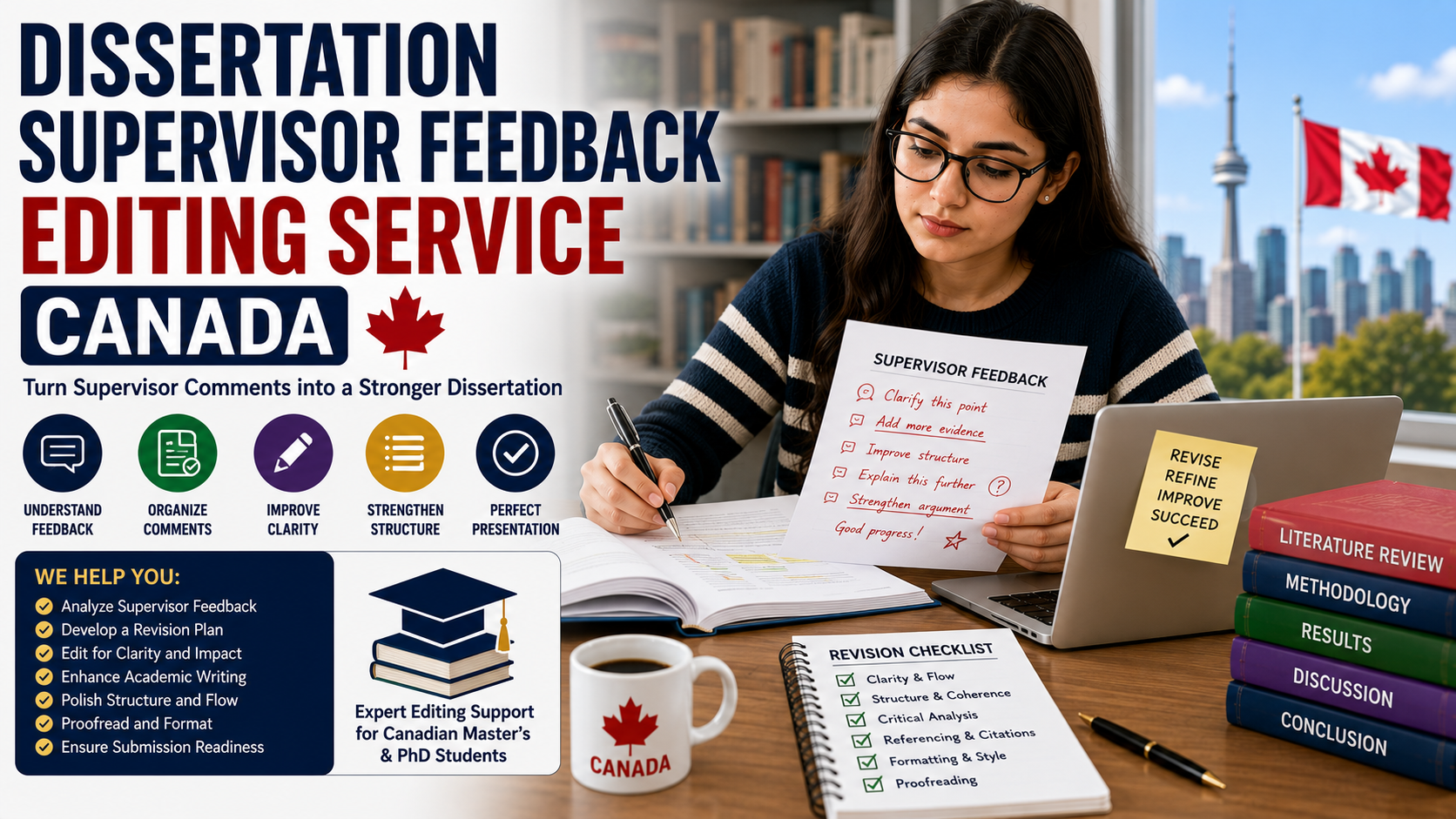
For Canadian Master's and PhD students, supervisor feedback often arrives after weeks or months of research and writing. The challenge is not always understanding individual comments. It is knowing how to turn dozens of comments into a structured revision plan without losing track of the bigger dissertation argument.
A dissertation supervisor feedback editing service in Canada can help students review and edit their existing work in response to supervisor comments. Depending on the service, this may involve language editing, structural consistency, proofreading, formatting and organising revisions.
However, students should remain responsible for their research, arguments, analysis and academic decisions.
What Is Dissertation Supervisor Feedback Editing?
Dissertation supervisor feedback editing is the process of reviewing an existing dissertation alongside supervisor comments and improving the document according to the requested revisions.
The process may involve:
Organising supervisor comments
Identifying repeated issues
Improving clarity
Correcting grammar
Strengthening transitions
Improving structural consistency
Checking terminology
Reviewing chapter organisation
Checking citations
Improving formatting
Proofreading revised sections
Editing support should not replace the student's intellectual contribution.
The student remains responsible for deciding how research questions, methodology, findings and arguments should be changed.
Why Can Supervisor Feedback Be Difficult to Manage?
Supervisor feedback is often delivered at different levels.
One comment may concern a sentence:
“Clarify this statement.”
Another may concern an entire chapter:
“The discussion needs restructuring.”
A third may concern the dissertation as a whole:
“The research contribution is not sufficiently clear.”
These comments require different responses.
Trying to address them all simultaneously can make revision unnecessarily confusing.
A better approach is to classify feedback before editing.
The Four Main Types of Dissertation Feedback
1. Language and Clarity Feedback
These comments usually concern:
Grammar
Sentence structure
Word choice
Academic tone
Repetition
Ambiguous statements
Poor transitions
Example:
“This paragraph is difficult to follow.”
The solution may involve restructuring the paragraph rather than simply correcting grammar.
2. Structural Feedback
Structural comments can involve:
Chapter organisation
Section order
Heading hierarchy
Paragraph sequencing
Repetition between chapters
Literature review organisation
Methodology structure
Discussion structure
Structural revisions can take considerably more work than proofreading.
3. Argument and Evidence Feedback
Supervisors may identify problems such as:
Unsupported claims
Weak evidence
Unclear reasoning
Missing literature
Contradictory arguments
Insufficient engagement with previous research
For example:
“You need to explain why this finding matters.”
This is not simply a grammar problem.
The student needs to determine what the finding means, how it relates to the research question and how it connects to existing scholarship.
4. Research and Methodology Feedback
A supervisor may ask for clarification regarding:
Research design
Sampling
Data collection
Data analysis
Theoretical framework
Methodological limitations
Ethical considerations
These revisions can affect the substance of the dissertation.
Students should make these academic decisions themselves or discuss them with their supervisor or supervisory committee.
What Should You Do After Receiving Supervisor Feedback?
Don't immediately start rewriting random sections.
Instead, follow a structured process.
Step 1: Read All Feedback
Read every comment before making major changes.
Step 2: Create a Revision List
Record:
Chapter
Section
Supervisor comment
Required action
Status
Step 3: Group Similar Comments
For example:
Clarity
Improve sentence structure
Define terminology
Reduce repetition
Literature
Add recent research
Strengthen synthesis
Explain research gap
Methodology
Clarify sampling
Explain research design
Step 4: Prioritise Major Changes
Structural and research-related issues should generally be addressed before final proofreading.
Step 5: Revise
Work through the document systematically.
Step 6: Check the Feedback Again
Confirm that each requested change has been considered.
Dissertation Supervisor Feedback Revision Checklist
Feedback | Revision Action | Status |
|---|---|---|
Clarify research question | Revise wording and alignment | ☐ |
Strengthen literature review | Improve synthesis | ☐ |
Add supporting evidence | Review relevant sources | ☐ |
Clarify methodology | Explain research decisions | ☐ |
Improve chapter structure | Reorganise sections | ☐ |
Strengthen discussion | Connect findings to literature | ☐ |
Reduce repetition | Edit overlapping sections | ☐ |
Improve academic language | Edit sentences and paragraphs | ☐ |
Fix referencing | Check citations and references | ☐ |
Update formatting | Apply required style | ☐ |
Final proofreading | Review revised dissertation | ☐ |
What Does a Dissertation Editing Service Do With Supervisor Feedback?
The exact scope varies between providers.
A professional editing service may help with the presentation and clarity of revisions, including:
Language Editing
Grammar
Sentence structure
Vocabulary
Academic tone
Clarity
Conciseness
Structural Editing
Heading consistency
Paragraph order
Chapter transitions
Repetition
Section consistency
Referencing Review
Citation consistency
Reference formatting
Missing reference identification
DOI and URL presentation where applicable
Formatting
Page numbering
Heading styles
Tables
Figures
Contents pages
Appendices
Proofreading
Typographical errors
Punctuation
Spelling
Formatting inconsistencies
Students should confirm whether substantive academic revision is included or whether the service is limited to language and presentation.
Can an Editor Implement Supervisor Comments?
An editor can help improve the presentation of revisions, but the student should determine the academic response to supervisor feedback.
For example, if the supervisor writes:
“Explain why this methodology was selected.”
The student should decide what methodological justification is appropriate.
An editor can then help improve the clarity and organisation of the student's explanation.
This distinction is important.
What Is the Difference Between Editing and Rewriting?
Dissertation Editing
Editing improves existing content.
It may involve:
Clarity
Grammar
Flow
Structure
Consistency
Academic presentation
Dissertation Rewriting
Rewriting can involve substantially changing the content itself.
Students should be careful with external assistance that crosses from editing into producing academic work on their behalf.
Always check your university's academic-integrity requirements before using external support.
How to Handle “Strengthen Your Literature Review”
This is one of the most common supervisor comments.
“Strengthen the literature review” could mean several things.
Your supervisor may want you to:
Add relevant sources
Remove irrelevant sources
Improve synthesis
Compare competing studies
Identify gaps
Explain theoretical disagreements
Connect literature to your research question
Update outdated evidence
Do not simply add more references.
A stronger literature review is not necessarily a longer literature review.
The goal is to demonstrate how existing research relates to your research problem.
How to Handle “Improve Your Discussion”
A supervisor may say:
“The discussion is too descriptive.”
This can mean that the chapter reports findings without sufficiently interpreting them.
A stronger discussion may need to explain:
What the findings mean
Why they matter
How they compare with previous research
Whether they support existing theories
Why unexpected results occurred
What the findings contribute
What limitations affect interpretation
The appropriate response depends on your research and supervisor's expectations.
How to Handle “Clarify Your Research Contribution”
This comment is particularly important for postgraduate dissertations.
Your contribution might relate to:
A research gap
New empirical evidence
A theoretical interpretation
A methodological contribution
A new application
A specific population
A particular geographical context
The student should identify the contribution based on their actual research.
An editor can help make an existing explanation clearer but should not invent a contribution.
How to Handle “Add More Evidence”
When a supervisor requests additional evidence, avoid inserting random citations.
Instead:
Identify the exact claim.
Determine what evidence is missing.
Search appropriate academic literature.
Evaluate the credibility of the source.
Determine whether the evidence actually supports the claim.
Add the source using the required citation style.
Update the reference list.
The quality and relevance of evidence matter more than simply increasing the number of citations.
Supervisor Feedback Editing for Canadian Master's Students
Master's dissertations can involve substantial supervisor feedback concerning:
Research questions
Literature review
Methodology
Data analysis
Discussion
Academic writing
Referencing
Formatting
Students approaching a final submission may benefit from separating academic revisions from language editing.
First address the substantive feedback.
Then perform detailed editing and proofreading.
Supervisor Feedback Editing for Canadian PhD Students
PhD dissertations can involve multiple rounds of revision.
Feedback may arrive from:
Supervisor
Supervisory committee
Department
External examiner
Internal examiner
Thesis defence committee
PhD candidates may therefore need a more detailed revision-management process.
A useful system is to maintain a master revision document containing:
Feedback source
Chapter
Page or section
Comment
Planned response
Revision completed
Verification status
This prevents important comments from being lost during multiple rounds of editing.
What About Examiner Feedback?
Examiner feedback can be different from ordinary supervisor comments.
Depending on the stage of the dissertation, examiner feedback may include requests for:
Clarification
Additional discussion
Corrections
Structural changes
Methodological explanation
Referencing corrections
Formatting changes
Students should follow the formal instructions provided by their university and supervisory team.
If revisions are required after a defence, keep a detailed record of every requested correction.
Dissertation Revision Matrix
A revision matrix can make the process much easier.
Chapter | Feedback | Required Action | Completed |
|---|---|---|---|
Introduction | Research gap unclear | Clarify research gap | ☐ |
Literature Review | Too descriptive | Improve synthesis | ☐ |
Methodology | Sampling needs explanation | Add methodological justification | ☐ |
Results | Tables unclear | Improve presentation | ☐ |
Discussion | Findings insufficiently interpreted | Strengthen analysis | ☐ |
Conclusion | Contribution unclear | Clarify contribution | ☐ |
References | Inconsistent formatting | Standardise references | ☐ |
This document can become your final revision checklist.
Common Problems When Responding to Supervisor Feedback
1. Making Changes Without Reading All Comments
You may fix one paragraph and accidentally create inconsistencies elsewhere.
2. Treating Every Comment as a Grammar Problem
Many comments concern argument, evidence or structure.
3. Adding References Without Synthesis
More citations do not automatically create a stronger literature review.
4. Making Major Changes Too Late
Structural changes become harder after formatting and final proofreading.
5. Ignoring Repeated Feedback
If the same issue appears several times, it may indicate a broader dissertation-level problem.
6. Removing Content Without Checking Its Purpose
Cutting sections simply to reduce word count can weaken the argument.
7. Changing Terminology Inconsistently
A key research term should be used consistently throughout the dissertation.
8. Forgetting Cross-References
If a chapter, figure or table moves, internal references may become inaccurate.
9. Not Updating the Table of Contents
Structural revisions can make the contents page outdated.
10. Submitting Without a Final Comparison
After revisions, compare the updated dissertation with the original feedback list.
How to Make Supervisor Feedback Editing More Efficient
Use a three-stage editing process.
Stage 1: Substantive Revision
Address:
Research questions
Arguments
Evidence
Methodology
Findings
Discussion
Conclusions
Stage 2: Structural Editing
Check:
Chapter order
Section order
Transitions
Repetition
Heading hierarchy
Stage 3: Language and Presentation Editing
Check:
Grammar
Spelling
Sentence structure
Referencing
Formatting
Tables
Figures
Pagination
This approach prevents students from spending hours proofreading sections that later need to be completely rewritten.
Should You Use AI for Dissertation Supervisor Feedback?
AI tools can potentially help students organise comments, create revision checklists or identify language problems.
However, students should consider:
University AI policies
Confidentiality
Research-data sensitivity
Intellectual property
Academic-integrity requirements
Disclosure requirements where applicable
Do not upload confidential participant information or unpublished research into an AI system without understanding the relevant risks and institutional rules.
AI should also not be relied upon to invent academic arguments, evidence or references.
What Should a Dissertation Supervisor Feedback Editing Service in Canada Offer?
If you are considering professional editing support, look for a service that clearly explains what it does.
Potential services include:
Feedback Organisation
Comment classification
Revision matrix
Chapter-by-chapter checklist
Academic Language Editing
Grammar
Clarity
Academic tone
Conciseness
Structural Consistency
Headings
Paragraph flow
Chapter transitions
Repetition
Referencing
Citation consistency
Reference formatting
Bibliographic checks
Formatting
Tables
Figures
Page numbering
Contents pages
Appendices
Final Proofreading
Typographical errors
Grammar
Punctuation
Formatting consistency
Always ask whether substantive academic writing is included or whether the service only edits material supplied by the student.
How to Choose Dissertation Editing Services in Canada
Check the Scope
Make sure you know exactly what the provider will edit.
Ask About Supervisor Feedback
Find out whether they can work from your existing feedback and revision instructions.
Check Academic Subject Experience
Dissertation terminology and conventions can differ significantly between disciplines.
Review Confidentiality
This is particularly important if your dissertation contains unpublished research.
Check Turnaround Time
Avoid leaving a complete dissertation revision until the final few days.
Ask About Revisions
Clarify whether the service includes a review of corrections.
Avoid Guaranteed Outcomes
No legitimate editing service can guarantee:
A specific grade
Supervisor approval
Examiner approval
Successful defence
Graduation
Academic Integrity and Dissertation Editing
Professional editing should not replace the student's academic responsibility.
Students should remain responsible for:
Research design
Data collection
Data analysis
Findings
Interpretation
Academic arguments
Research conclusions
Final submission
An editor can help improve the clarity and presentation of a student's work, but the student should make the academic decisions.
Before purchasing dissertation editing support, check the policies of your Canadian university and graduate program.
Final Dissertation Supervisor Feedback Checklist
Before submitting your revised dissertation, check:
All supervisor comments have been reviewed.
Major comments have been classified.
A revision matrix has been created.
Research-question issues have been addressed.
Literature-review feedback has been considered.
Methodology feedback has been addressed.
Results feedback has been addressed.
Discussion feedback has been addressed.
Conclusion feedback has been addressed.
Arguments are consistent across chapters.
New references have been verified.
Citations have been updated.
Tables and figures are updated.
Cross-references are accurate.
Table of contents is updated.
Formatting follows institutional requirements.
Final proofreading is complete.
Final PDF has been reviewed.
Academic-integrity requirements have been checked.
AI-use requirements have been checked where applicable.
Final Takeaway
Supervisor feedback is not necessarily a sign that your dissertation has failed.
In many cases, feedback is part of the normal research and revision process.
The key is to transform feedback into specific, manageable revision actions.
Use a revision matrix, prioritise substantive issues, revise your chapters systematically and complete language and formatting edits only after the major academic changes are finished.
If you choose dissertation supervisor feedback editing services in Canada, look for support that helps improve the clarity, consistency and presentation of your existing work while keeping you responsible for the research, arguments, analysis and final academic decisions.
Frequently Asked Questions
Everything you need to know about our services
Related Posts

Dissertation Rejected by Your Supervisor? Here's How to Recover

Supervisor Revision Support for New Zealand Master's Dissertations
