Emergency Proofreading Service for Canadian University Students
Introduction
Your assignment is finished. Your references are added. Your word count is within the limit. Then, just before submission, you notice awkward sentences, spelling mistakes, inconsistent formatting, or citations that don't look quite right.
When the deadline is only hours away, there may not be enough time for a complete rewrite. This is where an emergency proofreading service for Canadian university students can be useful.
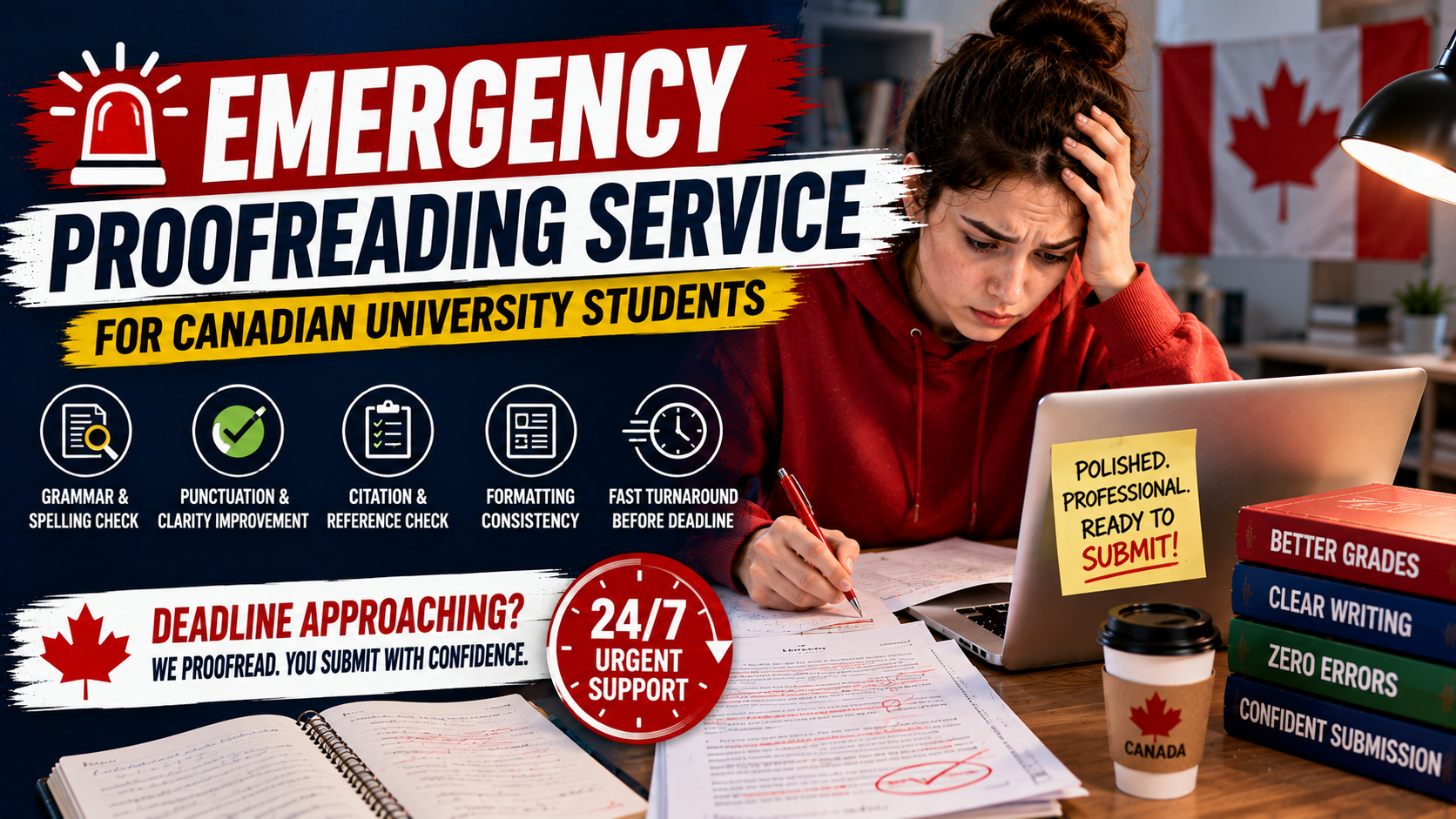
Proofreading is the final quality-control stage of academic writing. It focuses on identifying errors and inconsistencies in an existing document so that your work is clearer, more polished, and ready for submission.
This guide explains what emergency proofreading involves, what Canadian students should check before submitting university work, and how to prioritise proofreading when the deadline is approaching.
What Is an Emergency Proofreading Service?
An emergency proofreading service is a time-sensitive review of an existing academic document when a student has a short period before submission.
Depending on the service and document, proofreading may check:
Grammar
Spelling
Punctuation
Sentence clarity
Typographical errors
Capitalisation
Academic language
Terminology consistency
Headings
Formatting consistency
Citation presentation
Reference-list consistency
The exact scope depends on the provider, document length, academic level, subject, deadline, and type of proofreading requested.
Proofreading should generally improve the presentation of existing work rather than replace the student's ideas, research, analysis, or conclusions.
Why Canadian University Students May Need Emergency Proofreading
University deadlines can become particularly challenging when several academic responsibilities overlap.
You might have:
An essay due tomorrow
A research proposal due this week
A dissertation chapter requiring final review
Multiple assignments in the same period
A presentation and written report due together
Several references that need checking
Even after completing the main academic work, small errors can remain.
A final proofreading review gives you an opportunity to identify those issues before submission.
What Does Academic Proofreading Check?
Academic proofreading generally focuses on the surface-level quality and consistency of your document.
Grammar
Check for:
Subject-verb agreement
Incorrect verb forms
Sentence fragments
Incorrect tense
Misplaced modifiers
Inconsistent grammatical structures
Spelling
Look for:
Misspelled words
Typographical errors
Inconsistent spelling
Incorrect terminology
For Canadian university work, follow the spelling conventions required or expected by your institution, discipline, or assignment guidelines.
Punctuation
Review:
Commas
Full stops
Colons
Semicolons
Apostrophes
Quotation marks
Hyphens
Punctuation should make sentences easier to understand rather than unnecessarily complicating them.
Sentence Clarity
Some sentences may be grammatically correct but difficult to understand.
For example:
The results which were collected from the participants who completed the survey were analysed using the method that was selected by the researcher.
A clearer version might be:
The researcher analysed the survey results using the selected analytical method.
The exact revision should preserve the original meaning.
Proofreading vs Editing: What's the Difference?
Students often use the terms editing and proofreading interchangeably, but they are different stages.
Editing
Editing can address broader issues such as:
Structure
Organisation
Argument flow
Paragraph development
Academic clarity
Repetition
Transitions
Overall readability
Proofreading
Proofreading generally focuses on:
Grammar
Spelling
Punctuation
Typographical errors
Formatting inconsistencies
Terminology consistency
Obvious citation or reference errors
If your assignment has major structural problems, proofreading alone may not be enough.
If your document is already complete and well organised but contains errors, proofreading may be the more appropriate final step.
What Should Canadian Students Proofread Before Submission?
1. Assignment Requirements
Start with your assignment instructions.
Check:
Required word count
Academic level
Referencing style
Formatting
Required sections
File format
Submission method
Deadline
Any required declaration
Your university, faculty, department, or course instructions should take priority over generic online advice.
2. Title and Headings
Check whether:
The title matches the assignment
Headings are consistent
Heading levels are used correctly
Capitalisation is consistent
Required sections are included
A clear heading structure also makes the document easier to navigate.
3. Introduction
Your introduction should clearly establish what the assignment discusses.
Check for:
Unclear opening sentences
Repetition
Unnecessary background
Missing context
Weak transitions
Unsupported claims
Make sure the introduction actually reflects what the rest of the assignment discusses.
4. Main Body
Review each paragraph for:
Clear topic sentences
Relevant evidence
Logical explanations
Appropriate citations
Smooth transitions
Repetition
Proofreading isn't only about finding spelling mistakes. It is also about making sure the final text reads consistently.
5. Conclusion
Check whether the conclusion:
Summarises the main discussion
Addresses the assignment question
Avoids introducing unnecessary new arguments
Matches the content of the paper
A conclusion that doesn't reflect the main discussion can make an otherwise strong assignment feel incomplete.
How to Proofread an Assignment Quickly
If your deadline is approaching, don't simply read the document from beginning to end once.
Use a structured approach.
Pass 1: Structure
Check:
Title
Headings
Introduction
Main sections
Conclusion
References
Appendices
Make sure everything required is present.
Pass 2: Content Consistency
Look for:
Contradictory statements
Repeated information
Inconsistent terminology
Incorrect names
Incorrect dates
Inconsistent numbers
For example, if you state that a study included 150 participants in one section and 180 in another, the discrepancy needs to be investigated.
Pass 3: Citations
Check your in-text citations.
Look for:
Missing citations
Incorrect author names
Incorrect publication years
Inconsistent formatting
Citations that don't match the reference list
Pass 4: References
Review the reference list separately.
Check:
Author names
Publication years
Titles
Journal names
Volume and issue information
Page numbers
DOI information
URLs where required
The exact format depends on your required citation style.
Pass 5: Language
Now check:
Grammar
Spelling
Punctuation
Sentence clarity
Word choice
Typographical errors
Separating the checks makes it easier to notice problems.
Emergency Proofreading When Your Assignment Is Due Tomorrow
If your deadline is approximately 24 hours away, prioritise the most important issues.
First: Check Requirements
Make sure the document follows your university's instructions.
Second: Check Major Errors
Look for:
Missing sections
Incorrect data
Contradictory statements
Missing citations
Broken references
Formatting problems
Third: Check Academic Language
Review unclear or unnecessarily complicated sentences.
Fourth: Check References
Make sure your citations and reference list are consistent.
Fifth: Proofread
Correct spelling, grammar, punctuation, and typographical errors.
Sixth: Final Submission Check
Open the final file and verify that it looks correct before submitting.
What If Your Assignment Is Due Tonight?
When only a few hours remain, you need to prioritise.
Don't spend 30 minutes changing one sentence while an important citation is missing elsewhere.
Use this quick checklist:
Correct assignment title
Correct file format
Required sections included
Word count checked
Research question addressed
Major claims supported
Citations checked
Reference list checked
Tables and figures checked
Grammar checked
Spelling checked
Formatting checked
Submission instructions checked
Then save the final version separately so you don't accidentally submit an unfinished file.
Common Proofreading Mistakes Canadian Students Make
Proofreading Only for Spelling
Spelling is important, but it is only one part of proofreading.
A document can have perfect spelling and still contain:
Poor punctuation
Inconsistent citations
Repeated words
Grammar errors
Formatting problems
Reading Too Quickly
When you have written something yourself, your brain may automatically fill in missing words or overlook familiar errors.
Reading more slowly—or reviewing the document in sections—can reveal mistakes more effectively.
Checking Everything at Once
Trying to check grammar, citations, references, formatting, and structure simultaneously can become overwhelming.
Separate the review into stages.
Ignoring References
Students sometimes focus entirely on the main text and leave references until the final minute.
This can create avoidable problems.
Check your references before submission.
Making Unnecessary Changes
When a deadline is very close, extensive rewriting can introduce new errors.
If the document is already complete, focus on meaningful corrections and final quality checks.
How to Proofread a Dissertation Under a Tight Deadline
Dissertations require a broader proofreading strategy because they are much longer than typical assignments.
Check consistency across chapters.
Look for:
Research-question terminology
Research objectives
Chapter titles
Headings
Tables
Figures
Abbreviations
Citations
References
Methodological terminology
Participant descriptions
Results
Discussion
Conclusion
For example, if your dissertation refers to a particular group using three different terms, decide which term is appropriate and use it consistently where the meaning is the same.
Dissertation References
A dissertation may contain a large number of sources.
Check that:
Important in-text citations appear in the reference list
Reference entries are complete
Publication years are consistent
Author names are correct
The required referencing style has been followed
Do not assume that reference-management software has eliminated every possible error.
Emergency Proofreading for Research Proposals
Research proposals can also benefit from a final proofreading review.
Check:
Research question
Research objectives
Literature review
Research gap
Methodology
Sampling
Data collection
Research ethics
Expected contribution
Timeline
References
The proposal should be internally consistent.
For example, your proposed methodology should make sense in relation to your research question and objectives.
Emergency Proofreading for Essays
For essays, focus on:
Introduction
Clear topic
Relevant background
Thesis or central argument
Logical direction
Main Body
Topic sentences
Evidence
Analysis
Citations
Transitions
Conclusion
Main argument summarised
Assignment question addressed
No unnecessary new arguments
References
Correct citation style
Complete reference entries
Consistent formatting
Emergency Proofreading for Coursework
Coursework can include reports, case studies, reflective assignments, projects, and other academic documents.
The final review should reflect the specific assessment requirements.
Check:
Required sections
Learning outcomes
Assessment criteria
Tables
Figures
References
Formatting
Word count
If your coursework includes calculations, data, or statistical results, verify those carefully rather than relying only on language proofreading.
Can Professional Proofreading Help Before a Deadline?
Professional proofreading can be useful when your document is already written and you want an additional review before submission.
Depending on the service, a proofreading review may examine:
Grammar
Spelling
Punctuation
Sentence clarity
Academic language
Consistency
Formatting
Citations
References
The exact service varies between providers.
Students should provide the document, word count, academic level, subject, referencing style, and exact deadline so the required scope can be assessed.
What Is an Emergency Proofreading Service in Canada?
An emergency proofreading service in Canada is a time-sensitive proofreading service intended for students who have an approaching university deadline.
The service may be requested for:
Essays
Assignments
Coursework
Research proposals
Literature reviews
Dissertations
Theses
Reports
Case studies
Availability depends on the document's length, complexity, deadline, academic level, subject, and provider capacity.
How Much Does Emergency Proofreading Cost?
There is no single standard price for emergency proofreading.
Pricing can depend on:
Word count
Academic level
Subject
Document complexity
Deadline
Required turnaround
Depth of proofreading
Formatting requirements
A short essay requiring a basic proofreading review can have very different requirements from a lengthy dissertation requiring detailed formatting and reference checks.
If you are comparing services, provide your exact requirements and request a quote.
What Information Should You Provide?
If you need urgent proofreading, provide:
Document type
Word count
Academic level
Subject
Exact deadline
Referencing style
University requirements
Type of proofreading required
Any specific concerns
For example:
"I have a 4,000-word university assignment due tomorrow at 11:59 p.m. I have completed the content and references and need a final proofreading review for grammar, spelling, academic clarity, citation consistency, and formatting."
This gives the service provider a much clearer understanding of the task.
How to Choose an Emergency Proofreading Service
If you are considering professional proofreading, don't choose solely because a provider promises the fastest turnaround.
Consider:
1. Relevant Academic Experience
Does the service understand academic writing and your subject area?
2. Clear Scope
Does it explain exactly what proofreading includes?
3. Deadline Transparency
Can the provider clearly confirm whether your deadline is feasible?
4. Confidentiality
Understand how your document and personal information will be handled.
5. Referencing Knowledge
If citation consistency is important, check whether the service supports your required referencing style.
6. Clear Pricing
Understand what you are paying for before proceeding.
7. Originality and Academic Integrity
Make sure the service focuses on legitimate support such as proofreading and editing rather than completing assessed work on your behalf.
Academic Integrity and Proofreading
Proofreading should not be confused with having someone complete your academic work.
Your research, ideas, analysis, conclusions, and arguments should remain your own.
Appropriate academic support may include:
Identifying language errors
Improving clarity
Checking consistency
Highlighting formatting problems
Identifying obvious citation issues
Providing feedback on presentation
However, students should always check their university's academic-integrity and assessment policies before using external academic support.
Policies differ between institutions and courses.
Final Emergency Proofreading Checklist
Before submitting your university assignment, run through this checklist.
Content
Assignment question addressed
Main argument is clear
Evidence supports important claims
No major contradictions
Conclusion reflects the main discussion
Language
Grammar checked
Spelling checked
Punctuation checked
Sentence clarity checked
Academic tone consistent
Repetition reduced
Citations
Important claims have appropriate citations
Author names checked
Publication years checked
Citation format consistent
References
Reference list complete
In-text citations match references
Required style followed
DOI/URL information checked where required
Formatting
Headings consistent
Page numbers correct
Tables checked
Figures checked
Margins and spacing checked
Font requirements followed
Word count checked
Submission
Correct file selected
Correct file format
File opens correctly
Submission portal checked
Deadline confirmed
Submission confirmation saved
What to Do After Proofreading
Once the proofreading process is complete, avoid making unnecessary changes.
Instead:
Read the final version once.
Check the assignment requirements.
Confirm the file format.
Save a final copy.
Submit through the official university system.
Save the submission confirmation.
If your institution allows you to replace a submitted file, follow its official procedure rather than assuming you can upload a revised version.
Final Thoughts
When your university deadline is approaching, proofreading can be one of the final steps between completing your assignment and submitting a polished document.
The most effective approach is to prioritise major problems first, then review citations and references, and finally check grammar, spelling, punctuation, formatting, and consistency.
If you have already completed your academic work but don't have enough time for a thorough final review, an emergency proofreading service for Canadian university students may provide time-sensitive support, depending on the document and provider's availability.
Most importantly, keep your academic work your own, follow your university's policies, and verify every submission requirement before you click Submit.
Frequently Asked Questions
Everything you need to know about our services
Related Posts

Affordable Dissertation Proofreading Services in Canada

Assignment Proofreading Before Submission for NZ University Students
