Dissertation Referencing Help Before Submission in Canada
Introduction
Submitting a dissertation is the final step of a long research process. After months of reading literature, collecting data, analysing findings and revising chapters, referencing can seem like a small detail.
It is not.
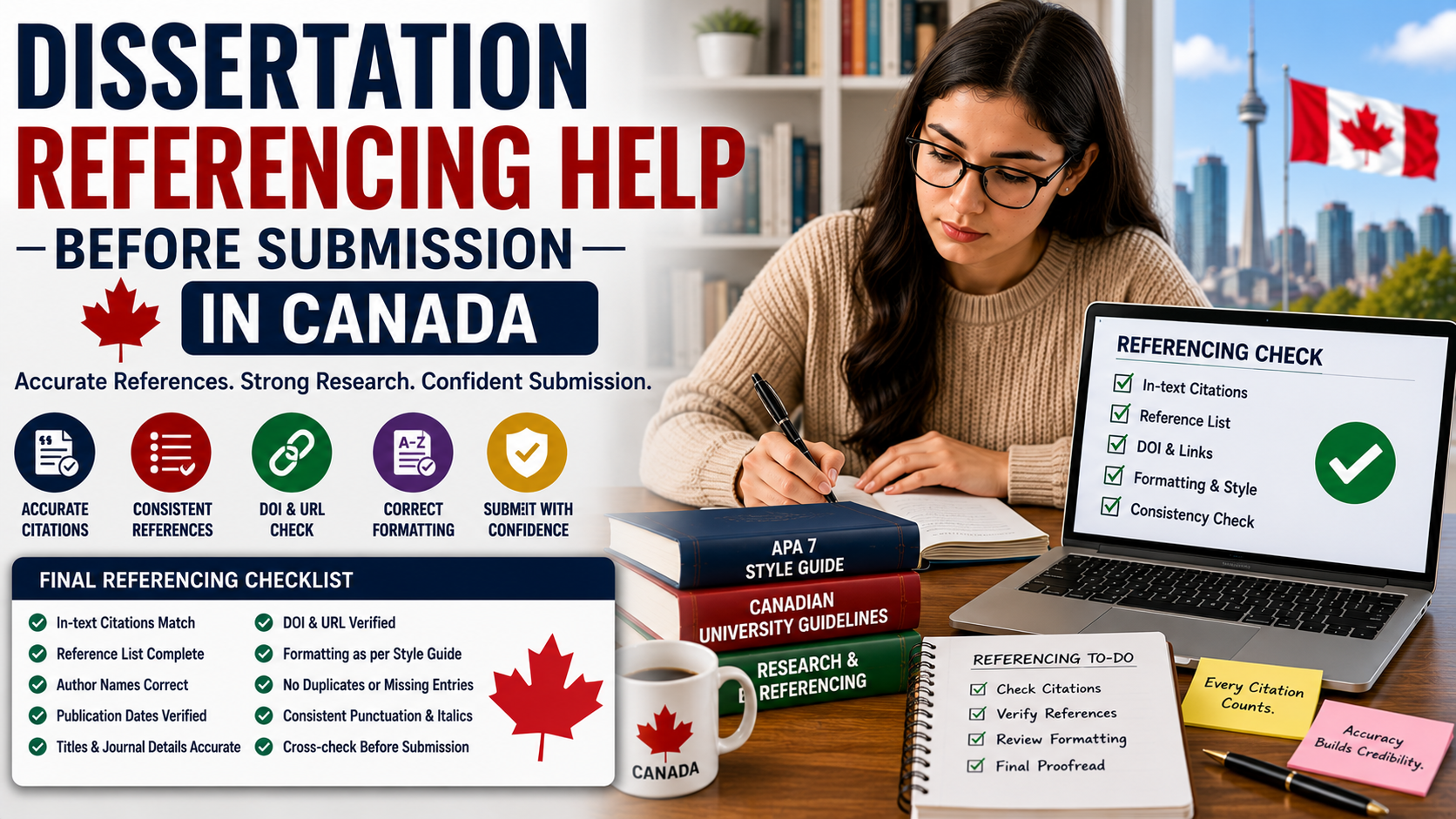
A dissertation may contain hundreds of sources across the literature review, methodology, discussion and conclusion. A single missing citation, inconsistent reference entry or incorrectly formatted source can create avoidable problems during the final review.
For Canadian Master's and PhD students, dissertation referencing help before submission can be useful when the research and writing are already complete but the references need a final consistency and accuracy check.
This guide explains what to review before submitting a dissertation, common referencing problems and how professional referencing support can help.
What Is Dissertation Referencing?
Dissertation referencing is the process of identifying and acknowledging the sources used to develop the research and arguments presented in a dissertation.
Referencing normally involves two connected components:
In-text citations or footnotes within the dissertation
Reference list or bibliography at the end
The exact system depends on the student's discipline and institutional requirements.
Common referencing systems include:
APA
MLA
Chicago
Vancouver
IEEE
Harvard
OSCOLA
Discipline-specific citation systems
Canadian universities do not necessarily use one universal referencing style. Students should follow the requirements specified by their faculty, department, supervisor or dissertation guidelines.
Why Is Referencing Important Before Dissertation Submission?
Referencing performs several important academic functions.
It allows readers to:
Identify the sources behind claims
Locate supporting evidence
Distinguish original research from existing scholarship
Evaluate the strength of an argument
Follow the development of an academic debate
Verify quotations and data
Understand how the research relates to previous literature
Accurate referencing also demonstrates academic care.
A dissertation with strong research but inconsistent citations can appear less polished than it actually is.
What Should You Check Before Submitting a Dissertation?
A final referencing review should go beyond checking whether the reference list "looks right."
Review the dissertation systematically.
Check 1: In-Text Citations
Look through every chapter and identify claims that require sources.
Check 2: Reference List
Confirm that cited sources appear in the reference list where required.
Check 3: Author Names
Check spelling and consistency of author names.
Check 4: Publication Dates
Verify that publication years are consistent between citations and references.
Check 5: Titles
Check book, article, report and webpage titles against the original sources.
Check 6: Journal Information
Where applicable, verify:
Journal title
Volume
Issue
Page range
DOI
Check 7: URLs
For online sources, check that URLs are complete and functional where required.
Check 8: Formatting
Check punctuation, italics, capitalisation, indentation and spacing according to the required style.
In-Text Citations vs Reference List
One of the most common dissertation referencing problems is inconsistency between citations and references.
For example, a dissertation may contain:
(Smith, 2023)
but the reference list might contain:
Smith, J. (2022)...
This creates uncertainty about which source the citation refers to.
A final check should compare citations against the reference list.
However, the exact rules depend on the referencing system being used.
What Is the Difference Between a Reference List and Bibliography?
The terms are sometimes used differently depending on the citation style and institution.
Generally:
Reference list: Sources specifically cited in the dissertation.
Bibliography: May include sources consulted during research even if they are not directly cited, depending on the required style.
Do not assume that every dissertation needs a bibliography.
Check your university and departmental requirements.
Common Dissertation Referencing Problems
1. Missing References
A source appears in the dissertation but is absent from the final reference list.
This is particularly common after multiple rounds of editing.
2. Unused References
A source appears in the reference list but is never cited in the dissertation.
This may or may not be acceptable depending on the required referencing system.
3. Inconsistent Author Names
The same author may accidentally appear in different formats.
For example:
Johnson, M.
and:
Johnson, Michael
The correct presentation depends on the citation style.
4. Incorrect Publication Dates
The year in the in-text citation may not match the year in the reference list.
This can become particularly complicated when an author has published multiple works in the same year.
5. Missing DOI
Some journal articles have DOI information that has been omitted from the reference entry.
Whether a DOI is required and how it should be presented depends on the citation style.
6. Incorrect Journal Details
Common errors include:
Incorrect volume
Incorrect issue
Incorrect page numbers
Misspelled journal title
Incorrect article title
These details should be checked against the original publication.
7. Broken URLs
Online sources can change or become unavailable.
Check important URLs before submission where the citation style requires them.
8. Inconsistent Capitalisation
Reference styles often have specific rules for capitalisation.
Do not manually apply a generic capitalisation rule to every source.
9. Incorrect Italics
Journal titles, book titles, volume numbers and other elements may require specific formatting depending on the citation style.
10. Incorrect Citation of Secondary Sources
Sometimes students cite a source they encountered through another author's work without making the distinction clear.
If you have not read the original source, follow the appropriate secondary-citation rules rather than implying that you directly consulted it.
How to Check APA 7 Dissertation References
If your Canadian program requires APA 7, review the applicable APA requirements for:
Author formatting
Publication dates
Titles
Journal information
DOI presentation
Website references
Book references
Edited books
Chapters
Reports
In-text citations
Multiple authors
Secondary sources
Do not assume that every Canadian university requires APA 7.
APA 7 is common in disciplines such as psychology, education, nursing and social sciences, but institutional and departmental requirements vary.
Dissertation Referencing in the Humanities
Humanities dissertations may use citation systems such as:
Chicago
MLA
Discipline-specific styles
Depending on the requirements, students may need to manage:
Footnotes
Endnotes
Bibliographies
Archival sources
Books
Edited collections
Primary sources
Historical documents
The final referencing review should follow the specific style required by the student's program.
Dissertation Referencing in Business and Social Sciences
Business and social-science dissertations may rely heavily on journal articles, books, reports and online datasets.
Students should check:
Author-date citations
Multiple citations
Corporate authors
Reports
Statistical sources
Government publications
Datasets
Websites
Particular attention should be paid to sources cited throughout the literature review and discussion chapters.
Dissertation Referencing in Nursing and Health Sciences
Health-related dissertations can contain a large number of journal articles and clinical or government sources.
Students may need to reference:
Peer-reviewed research
Clinical guidelines
Government reports
Institutional publications
Systematic reviews
Books
Online medical resources
Depending on the program, citation systems such as APA or Vancouver may be required.
Always follow the applicable program guidelines.
Dissertation Referencing for Canadian Law Students
Law dissertations can require particularly detailed citation practices.
Depending on the program and jurisdiction, students may encounter:
Cases
Legislation
Regulations
Books
Journal articles
Government documents
Online legal sources
A law student should use the citation system required by their institution and discipline rather than automatically applying APA or Harvard referencing.
How to Check Every Citation Before Submission
A useful final-review process is:
Step 1: Start With Chapter One
Check every citation.
Step 2: Continue Chapter by Chapter
Do not try to check the entire dissertation randomly.
Step 3: Record Problems
Create a simple checklist containing:
Citation
Reference-list entry
Problem
Correction required
Step 4: Check the Original Source
For questionable references, verify the information against the original publication.
Step 5: Check the Reference List
Confirm that entries correspond with citations.
Step 6: Update the Reference Manager
If you use software such as Zotero, EndNote or another reference-management system, update the underlying records.
Step 7: Perform a Final Manual Review
Software can identify many problems, but it cannot always determine whether a citation is academically appropriate.
Can Reference Managers Prevent Dissertation Referencing Errors?
Reference-management software can significantly reduce repetitive work.
Common tools include:
Zotero
EndNote
Mendeley
Other university-supported reference-management systems
These tools can help with:
Storing references
Generating citations
Creating bibliographies
Changing citation styles
Organising sources
Reducing repetitive manual entry
However, reference managers are not perfect.
Imported metadata can contain errors.
For example, a database may import:
Incorrect author names
Wrong publication dates
Incorrect capitalization
Missing DOI information
Incorrect journal details
Therefore:
Always verify automatically generated references against the original source and your required citation style.
How AI Can Affect Dissertation Referencing
AI tools can help students identify possible formatting inconsistencies, but they should not be treated as authoritative citation databases.
One important risk is fabricated or inaccurate references.
An AI system may produce a citation that looks legitimate but does not actually exist or contains incorrect bibliographic information.
Students should therefore:
Verify every citation.
Check the original publication.
Confirm the author.
Confirm the title.
Confirm the publication date.
Confirm the journal or publisher.
Confirm DOI information where applicable.
Follow their university's AI-use requirements.
Never add an AI-generated reference simply because it looks plausible.
What Is Dissertation Referencing Help?
Dissertation referencing help is academic support that assists students with checking, organising and improving the referencing of their existing dissertation according to the required citation style.
Depending on the service, it may include:
Citation consistency checks
Reference-list checks
Formatting reviews
Missing-reference identification
Duplicate-reference identification
DOI checks
URL checks
Author and date consistency
Citation-reference matching
Bibliography organisation
Style-consistency review
Students should clarify exactly what is included before ordering a service.
Dissertation Referencing Help vs Dissertation Writing
These are very different forms of support.
Referencing Support
Can involve:
Checking existing citations
Correcting formatting
Identifying inconsistencies
Reviewing reference entries
Improving citation organisation
Dissertation Writing
Involves producing substantial academic content.
Students should remain responsible for their research, arguments, findings and final academic submission.
Before using external academic support, students should check their university's academic-integrity policies.
When Should You Get Dissertation Referencing Help?
The best time to check references is before the final submission deadline, not the night before.
Consider a final referencing review when:
Your dissertation has undergone many revisions.
You have added or removed literature.
Your supervisor has requested major changes.
You changed citation styles.
You imported references from multiple databases.
You converted citations manually.
You have hundreds of references.
Your dissertation contains many online sources.
You are unsure whether all citations match the reference list.
You are preparing the final PDF.
The earlier you identify problems, the easier they are to correct.
How to Choose Dissertation Referencing Help in Canada
If you are considering professional referencing support, evaluate the service carefully.
1. Check Citation-Style Experience
The provider should understand the specific style required by your program.
2. Ask Whether References Are Verified
Formatting a reference and verifying its bibliographic accuracy are not the same thing.
3. Ask About Large Reference Lists
A dissertation may contain hundreds of sources.
4. Check Whether Citation Matching Is Included
Ask whether the service checks both directions:
In-text citation → Reference list
and:
Reference list → In-text citation
5. Ask About Confidentiality
Dissertations may contain unpublished research and sensitive information.
6. Check Revision Policies
Clarify whether corrections identified after the first review are covered.
7. Check Academic-Integrity Policies
Make sure the support you receive is permitted by your university.
Final Dissertation Referencing Checklist
Before submitting your dissertation, ask:
Citation Check
Does every major sourced claim have an appropriate citation?
Are citations placed next to the claims they support?
Are author names correct?
Are publication dates correct?
Are multiple-author citations formatted correctly?
Are secondary citations handled correctly?
Reference List Check
Does every required cited source appear in the reference list?
Are unnecessary entries removed where required?
Are duplicate references removed?
Are author names consistent?
Are publication dates correct?
Are titles accurate?
Are journal details accurate?
Are DOI details correct where required?
Are URLs correct where required?
Formatting Check
Is the correct citation style being used?
Is capitalization consistent?
Is punctuation consistent?
Are italics correct?
Is indentation correct?
Is spacing consistent?
Are tables and figures referenced appropriately?
Final Submission Check
References have been checked after the final edits.
The reference list has been updated.
The final PDF has been reviewed.
University submission requirements have been checked.
Academic-integrity requirements have been reviewed.
AI-use requirements have been checked where applicable.
Final Takeaway
A dissertation's referencing system should be treated as part of the research presentation rather than an afterthought.
Before submitting a dissertation in Canada, review the document systematically for:
In-text citations → Reference-list matching → Bibliographic accuracy → Citation-style consistency → Formatting → Final submission compliance
If you use professional dissertation referencing help, choose support that focuses on accuracy, consistency, verification and permitted academic editing rather than simply generating large numbers of citations.
Most importantly, follow your own university, faculty and departmental requirements, because Canadian institutions and disciplines can use different referencing conventions.
Frequently Asked Questions
Everything you need to know about our services
Related Posts

Academic Referencing Correction Service for New Zealand Students

Annotated Bibliography Help for New Zealand University Students
